

Why Your Child Is Probably Not Addicted to Video Games: A Q&A with @thegamereducator Ash Brandin
How Video Games Can Support Autonomy

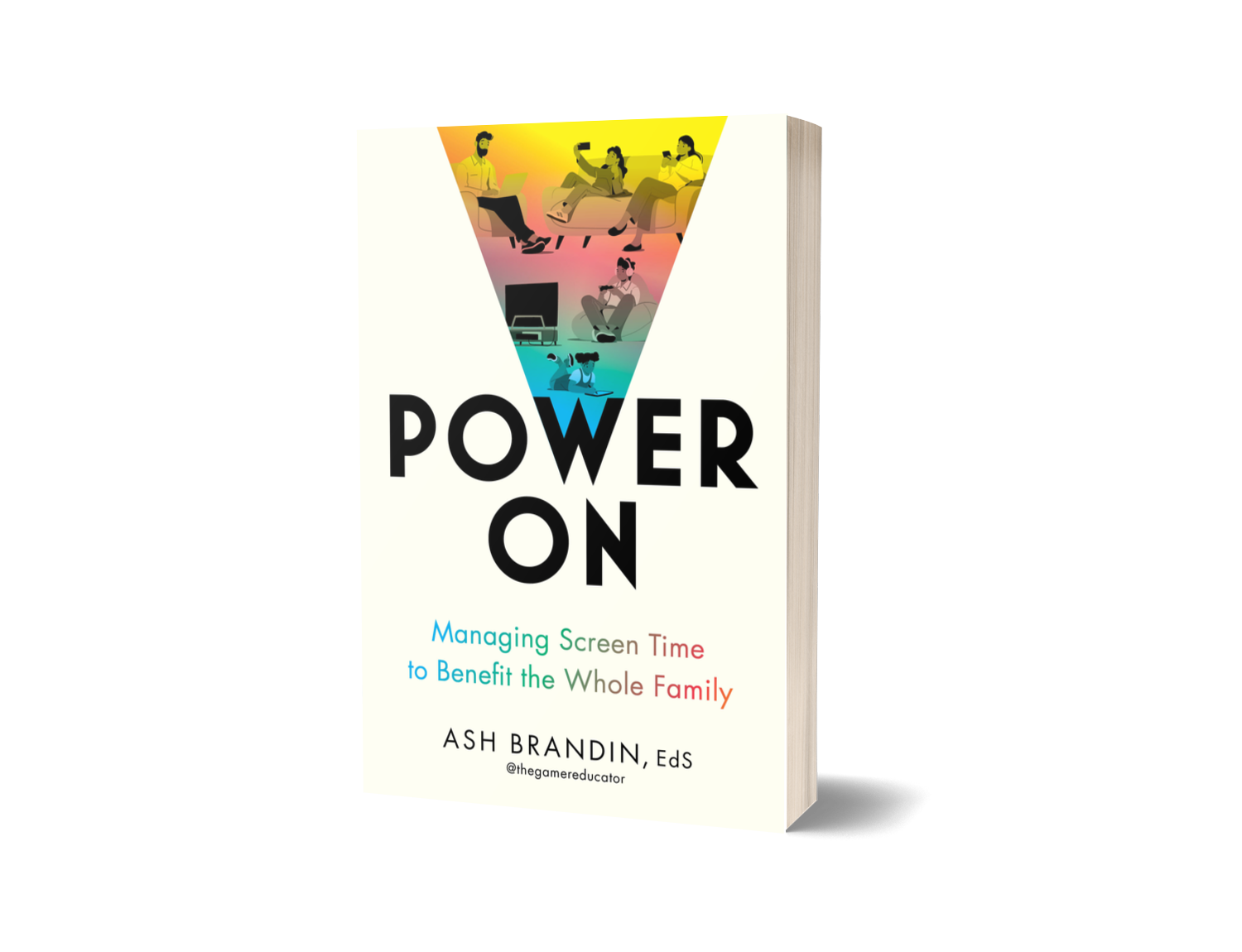
When I saw Ash Brandin had a book coming out, I immediately reached out to invite them onto my Psychologists Off the Clock podcast.
If you’re on Instagram and don’t follow @thegamereducator, remedy that this minute! If you’re not on Instagram, you can find them right here on Substack, at
. Ash Brandin, middle-school educator (bless them!) and self-proclaimed gamer, offers a voice of reason and common-sense around screen time that needs amplification (even though they have an astounding 237k followers on IG).This excerpt of our interview focuses on video games but the entirety of our discussion and Brandin’s book, Power On: Managing Screen Time to Benefit the Whole Family, addresses screen time more generally as well. In other parts of our interview we talked about taking a morally neutral stance towards screens as a valid form of leisure, centering social equity issues in discussions about screen time, and more on research about addictive gaming behaviors. Brandin also provides tables of strategies to guide an approach to screen time that fits each family.
Let’s get to the interview!
Gifts of Gaming: Meeting a Child’s Fundamental Needs
Emily: Something that you may not realize you and I have in common is a love of self-determination theory. Self-determination theory lays the scientific foundation of my book on autonomy-supportive parenting and you use it to build your argument about how to more effectively parent when it comes to screens.
Just a quick reminder for readers: self-determination theory is looking at needs of autonomy, competence, and relatedness as the three fundamental human needs for a more fulfilled, higher quality of life. It’s backed up by decades of science.
Could you talk about how self-determination theory relates to screens?
Ash Brandin: Absolutely. It’s the whole idea of intrinsic motivation that things we enjoy doing are going to give us these needs. They’re gonna make us feel in control, somehow relating to other people, and more sure of ourselves, confident, competent in some way.
And video games are incredibly good at doing this. This is why a lot of kids like things like Minecraft because there’s no rules at all and they are given so much autonomy. Especially after a day of school - I say as a public school educator, they have zero autonomy all day long - and they’re just craving autonomy.
And then they can open up a world and no one is gonna tell them that they’re “doing the wrong thing” and “that doesn’t go there” and “why are you doing that?” When they get an idea, they can continue to work toward completing it. Or if they’re playing something more objective driven, they see the level they wanna try and complete and they can try to keep going there and they’re gonna fail.
They’re gonna fail again and again and again and again. But when they fail, the game says nothing. The game gives almost no feedback of any kind. The game doesn’t say, why do you keep doing that? You keep trying that, I think you should stop, or Do you need help? Are you sure you know what you’re doing?
The game just says: here’s the goal, do it or don’t.
And so then when they do succeed, they get this rush of competence. It’s like, oh my gosh, I did it right. I did the thing. And they’re not doing it for stars and badges and external rewards necessarily.
I brought [Self-Determination Theory] into the book because really that’s just about intrinsic motivation, right? If we were to substitute talking about video games right now with talking about learning to paint or spin clay on a wheel or kick goals in soccer, we could see all of those same things, those same psychological needs being met.
When [the child’s needs are] met through one of those other hobbies, we are very quick to go, oh, isn’t that great? They just wanna go to soccer every single day. We would probably not say, I’m really worried they’re getting addicted to soccer.
Need Density Hypothesis: Justice for Minecraft!
Ash Brandin: The need density hypothesis1 basically says a video game is going to accomplish that need satisfaction [fulfillment of the three fundamental human needs autonomy, competence, and relatedness] more consistently, more immediately, and more densely. Because the game’s going to behave the same way every time.
It’s giving you immediate and consistent feedback, and therefore you’re getting that feeling of competence or autonomy or relatedness more densely, more quickly than if you were to go do that out in the real world.
If that is the only way that they’re meeting that need, then it can be something that leads to an unhealthy or potentially “addictive” relationship to something. But again, that isn’t unique to technology.
It can be anything but we don’t want that to be the only way that someone is meeting a need. If they think “Every time I come home from school, I’m so tired of being told what to do. I want to feel in control,” if the only way they know how to feel in control is to play Minecraft then, yeah, that’s what they’re gonna do every day.
But that’s not because they’re addicted to Minecraft. It’s because they want to feel in control.
And why I think it’s so important to stay neutral is that if I’m blaming the screen, then all I see is the problem is my kid likes Minecraft too much. But if I’m staying neutral and going, What is it they like? What are they getting from this? Exactly what need is being satisfied by this?
If it’s a chance to explore freely and feel in control, there are many ways to achieve that. And now I can go, oh, okay - you can play Minecraft for half an hour and then we’re going to build with Lego, or we’re gonna draw, or we’re gonna make a recipe.
We want them to have other ways of meeting that need so that they don’t think that the only way they feel in control is playing Minecraft because we don’t want them to think I’m only good at Minecraft. We want them to think, I’m good at being creative.
Video Games and Cocaine Are Different
Emily Edlynn: I do want to quickly touch on dopamine because as a psychologist, the way popular media often discusses dopamine really frustrates me.
Ash Brandin: I was gonna say, I bet you must be so angry, like it makes me angry and I’m not in the profession.
Emily Edlynn: Just remember - anything pleasurable releases dopamine. It doesn’t mean it’s addictive.
Ash Brandin: I cannot tell you how validating this is because I am saying that but I’m not a psychologist.
Emily Edlynn: So cocaine and video games are different.
Ash Brandin: Yes. Actually in the book I mentioned earlier, Rigby and Ryan’s Glued to Games, they bring up what they call the dopamine hypothesis where they say, cocaine is a chemical. Video games are not a substance.
Emily Edlynn: Cocaine is changing your brain because it’s a chemical agent going into your body. Whereas video games, it’s all the external experience of the video game that is affecting the dopamine release.
Ash Brandin: And the oversimplification of that comparison is so insidious I think in a lot of ways and predatory on parents, but also it imagines that video games are one thing and I find that to be such an outdated way of looking at them.
I’m like, is this 1985? Why are we talking about video games as if they are one thing? Video games are thousands of different iterations and versions and lengths and delivery mechanisms.
Emily Edlynn: And they’re not inherently addictive! For example, I do not enjoy video games. I have tried, I have sat down with them. They’re not my thing. They don’t release dopamine for my brain.
Ash Brandin: Exactly. I’ve said this before of like, I don’t like Minecraft. Like you could stick me in a room for a month. I’m not gonna come out addicted to Minecraft because I don’t like Minecraft. So no, it is not just some insidious dopamine machine.
Thanks so much, Ash!
I recorded this interview weeks ago and I’ve been thinking about it ever since. I’m thrilled it’s out in the world and that Ash speaks in alignment with the mission of releasing fear and anxiety from the world of technology and parenting. If reading this helped you exhale a sigh of relief that you are not ruining your child by allowing screen time/video games, you will love listening to the entire interview.
What’s your parenting experience with gaming? Love it yourself, don’t understand it, and/or worry about your kids? Please share!
The Political Is Personal
Friends, I’m writing to you from my home in a village called Oak Park that borders Chicago. ICE has been terrorizing our neighborhoods and other communities all around Chicagoland. I feel powerless but one thing I can do is use this platform to communicate the reality of what’s happening on the streets.2
Federal agents in unmarked cars are patrolling residential streets looking for anyone who appears to be an immigrant. Legal U.S. citizens are being grabbed from the sidewalk (in one case from the seat of a running lawnmower) to be thrown in an ICE sedan and detained. If you haven’t heard, the Broadview detention center just a few miles from my house has been the site of daily protests, illegal behavior like pepper-spraying peaceful crowds, and not allowing our U.S. congressional representatives inside (also illegal). A judge has mandated improvements to address the detention center’s “unnecessarily cruel” conditions.
A daycare teacher with a legal work permit was arrested in front of young students. A father of a 16-year-old with stage 4 cancer was finally returned home after determining his detention was “unlawful.” A church’s lead pastor was shot in the head with a pepper ball while legally protesting.
Just blocks away from my house, ICE spent this past weekend picking up laborers even when being told they have papers in their truck (this was caught on video). The prolific ICE activity on Saturday stopped a Girl Scout troop’s cookie-selling because the troop didn’t feel safe walking our tree-lined, usually quiet streets.
If you are fortunate enough to not live somewhere this is happening, I want you to know in my spin-free zone what the reality is: it’s as if no constitution exists. It’s terrifying.
But it’s not hopeless. Last week, a brave group of mothers, many of whom hailed from my Oak Park, made national headlines for being arrested during their peaceful protest. I’m proud I live in a community where people take a stand and speak up for those being victimized and persecuted for the color of their skin. White parents are walking brown children to their elementary schools. Whistles to quickly announce the presence of ICE are the latest accessory for going on walks.
This is the world we live in right now. A world where federal agents violate the law and the U.S. constitution. Racial profiling. Innocent people torn from their families. Violent acts to suppress the American pillar of peaceful protest.
But we also live in a world where people are taking action and fighting. If you are moved to take action, you can donate to the Illinois Coalition for Immigrant and Refugee Rights or The Resurrection Project as just a couple of choices. As long as we have hope and faith in the good of enough people, all is not lost.

Alright my parent and caregiver community, enjoy the calm before the storm of holiday season!
In parenting solidarity,

Ash references the source of this hypothesis as the book, Glued to Games: How Video Games Draw Us In and Hold Us Spellbound, by Scott Rigby and Richard Ryan (a founder of Self-Determination Theory)
I do not take lightly the choice to include this in today’s newsletter. In our climate of polarizing politics and toxic division, I am conscientious about protecting this space as one where we unite in common struggles and motivations related to parenting. However, politics cannot be neatly excised from the rest of our lives, and I always say that parenting is a form of activism. Due to the extreme impact of the ICE presence on my community, this is my way of taking a stand that aligns with my morals and values.
I am a big fan of Ash's work and really appreciate the nuance of their book. Ash really presents a balanced way to approach tech based on an individual families needs and unique kids. And Emily, I share your frustration with incorrect representations around dopamine in the popular press.
Thank you! Video games CAN support autonomy *and* the development of valuable skills, as I've written about here (https://buildingboys.net/fortnite-is-not-a-waste-of-time/) and here (https://buildingboys.substack.com/p/video-games-arent-bad-really). I once led a session at a homeschool conference entitled "Video Games Aren't the Enemy," going into how video games can be used as learning tool, and a number of kids/teens came up to thank me afterward because the conflict that arises when adults misunderstand & demonize gaming is uncomfortable for them and destabilizing for the whole family. Also: you've got some great quotes in this post! ("Video games aren't cocaine." and "Is this 1985?)